A pool connection is not the same thing as useful work being accepted. A monitoring application should make that difference obvious. It should also distinguish the protocol used to exchange mining jobs from an HTTP interface used to display account or worker information. Both may be described casually as a mining pool API, but they have different roles and different failure modes.
This guide proposes a pool-observation model for a developer building a read-only monitoring view. It focuses on worker identity, submission states, reconnects, accounting boundaries, and useful incident context. Begin with the Mining Pools topic page for the navigation path, then use the examples here to design a response contract without assuming that every pool implements the same interface.
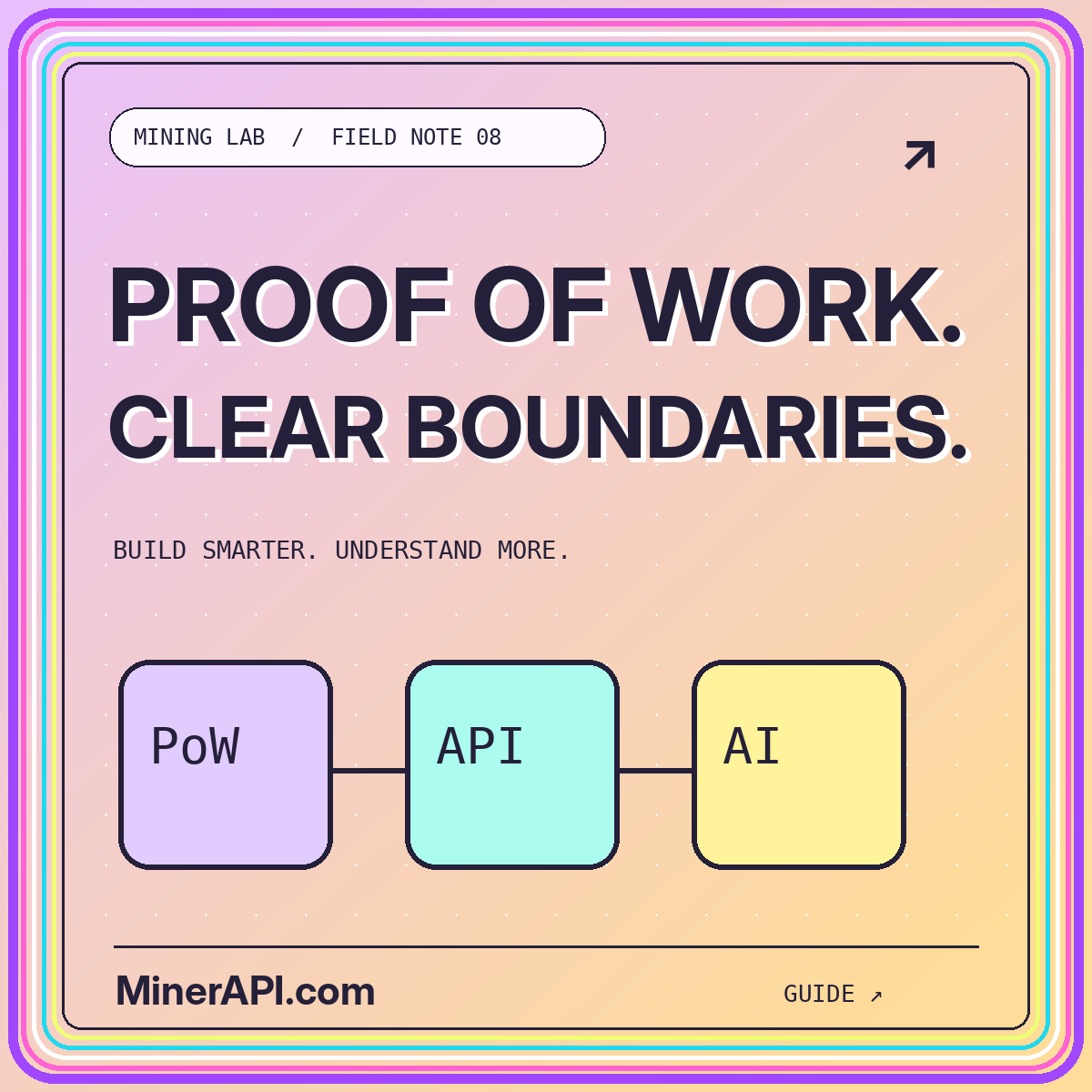
Separate job transport from account reporting
The Stratum V2 mining protocol specification describes channels, mining jobs, and share submission messages. It is a protocol reference, not a promise that every pool offers a particular browser-facing REST endpoint. An integration must verify the actual protocol and reporting interfaces supported by the pool and software in use.
Model job transport, worker telemetry, and account reporting as separate layers. A developer may obtain connection information from mining software while obtaining aggregated worker observations from a pool's documented reporting interface. Those sources can update at different times and use different identifiers. Preserve the source and observation timestamp for each. This allows the UI to show related evidence together without incorrectly claiming that one source directly measured another source's state.
Define worker identity across the boundary
Create a mapping between your internal worker identifier and the identifier recognized by the pool. Keep display names separate and document whether multiple devices share a pool-side name. Otherwise an operator may compare one device's local performance with a pool estimate that actually covers several devices. That mismatch can look like a serious fault when it is really an inventory problem.
Store the mapping as configuration rather than inferring it from string fragments in every request. Record changes when a worker is renamed or moved between endpoints. Historical observations should retain the identity mapping that applied at the time. For public examples, use fictional account and worker names. Do not publish real payout addresses, private account identifiers, or credentials merely to make sample payloads look authentic.
Represent connection and work states independently
A connection state tells you about communication, while a work state tells you about the activity being observed. Use separate fields for the latest connection observation, latest job observation, latest submission attempt, and latest acknowledgment where those signals are available. Do not derive all of them from a single boolean named online.
For example, a fictional worker can be connected while awaiting usable work, or sending submissions while the reporting interface is temporarily delayed. Present those states as observations, not as a definitive diagnosis. An overview might say “connection observed; recent acknowledgment unavailable.” That wording is less dramatic and more useful than declaring a hardware failure without evidence. The detailed view should show the timestamps and sources that support the summary.
Give submission counters a clear definition
If a source reports accepted, rejected, or stale submissions, preserve its documented definitions. Record whether counters are cumulative, windowed, or reset when a process reconnects. A change in a cumulative counter is not meaningful until you know whether the counter reset. Include an observation window for calculated rates and retain the raw counts for inspection.
For a fictional interval with 990 accepted submissions and 10 rejected submissions under the same counting rules, the rejected proportion is one percent of the 1,000 total counted submissions. Do not substitute a different denominator or mix counts from different windows. Some systems use variable share difficulty, so a raw count should not automatically be treated as equal work or revenue. A useful dashboard states exactly what its percentage measures.
Make reconnects and failover visible
Record connection transitions as events rather than erasing the previous endpoint when the next one becomes active. Store the time, prior endpoint label, new endpoint label, and the reason supplied by the source when available. If the reason is unknown, keep it unknown. An event history is more useful than a retrospective story invented from a gap in the chart.
During a failover test, watch how worker identity, counters, and observation timestamps behave. The monitoring system should not double-count activity from overlapping reporting windows or interpret a reset counter as negative work. Keep operational endpoint details out of public pages unless publication is intentional. A sanitized label can give a reader enough context without exposing private network configuration or account information.
Design a collector that respects source limits
Read the source's documented access and rate-limit requirements before choosing a schedule. Cache shared observations so each browser visitor does not produce a fresh upstream request. Use bounded retries and make rate-limited responses visible as collection states. Do not present a stale cached result as newly observed simply because the web server delivered it successfully.
Choose which fields the application actually needs. A fleet overview may only require worker identifiers, a documented performance window, and collection freshness. Pulling account details that you never display increases the amount of sensitive information you have to protect. Keep credentials in an authorized server-side collector, not in HTML, downloadable examples, or a public repository. The API security guide explains that separation in more detail.
Avoid turning monitoring data into a payout promise
A worker-status response is not a financial settlement record. Keep operational observations separate from account balances, payout records, and any economic model. Even when a source provides several of these together, the interface should distinguish what has been observed, what has been estimated, and what has actually been recorded as a transaction.
For an educational or demo dashboard, omit financial projections unless you have a clearly specified model and verified inputs. Use sample counts and connection states to demonstrate the interface instead. MinerAPI.com's demo does not connect to a pool account or report mining proceeds. Its purpose is to show how a developer might structure a transparent read-only response. That is useful without borrowing the credibility of a real provider's live account data.
Rehearse an investigation from the operator's view
Construct a fixture in which local activity continues but recent pool acknowledgments are unavailable. Ask an operator to identify the affected worker, the last known successful observation, and which source is missing. The next step should be to inspect the relevant collector or protocol evidence, not automatically restart every rig. A dashboard should narrow the search rather than prescribe a disruptive action from incomplete information.
Create a second fixture with a worker mapping error and a third with an endpoint change. These cases test whether the interface can explain disagreement without confusing identity, timing, and transport. Keep the fixtures in a regression set. Whenever labels or aggregation logic change, replay them and confirm that the operator still reaches a sensible interpretation. The alert design article turns this approach into an actionable notification plan.
Conclusion: preserve the boundaries of the evidence
A mining pool integration becomes easier to understand when job transport, worker telemetry, and account reporting remain distinct. Keep identity mappings explicit, submission counters well defined, and reconnect histories visible. Treat missing acknowledgments as a reason to investigate rather than an automatic diagnosis. Build the view around documented source behavior and reproducible fixtures, then connect it to authorized reporting interfaces only after those foundations are dependable.