Freshness, identity, units, source attribution, and alerts built from observations rather than guesses. This topic collection connects 6 field guides across the Mining Lab so you can follow the implementation question rather than reading every article in publication order.
Begin with the guide closest to your current task, then follow its links to related concepts and the relevant API topic page. The articles keep examples separate from live services and point to one primary technical reference for further detail. Use the public JSON fixtures to test presentation and validation before connecting your own authorized environment.
As you read, keep a short record of the assumptions that matter to your application: the source of an observation, the response version, the expected units, and the behavior when a request fails. That record makes the examples easier to adapt without inheriting claims that do not apply to your system.
Mining Alerts That Lead to Useful Action
Build quieter, more useful notifications with freshness rules, persistence, recovery states, and runbooks that preserve the evidence.
Read the field guide 7 min ↗
Hashrate and Difficulty: Read Mining Data Correctly
Understand measurement scope, averaging windows, unit conversions, and why a missing observation should never become an invented zero.
Read the field guide 6 min ↗
GPU Miner API: Metrics That Actually Matter
Keep hardware observations, mining-process activity, and upstream results separate so your GPU dashboard answers the right questions.
Read the field guide 7 min ↗
Bitcoin Miner API: A Practical Developer Guide
Separate node, device, and pool data. Build a read-only integration with explicit units, fresh observations, and reliable failure states.
Read the field guide 6 min ↗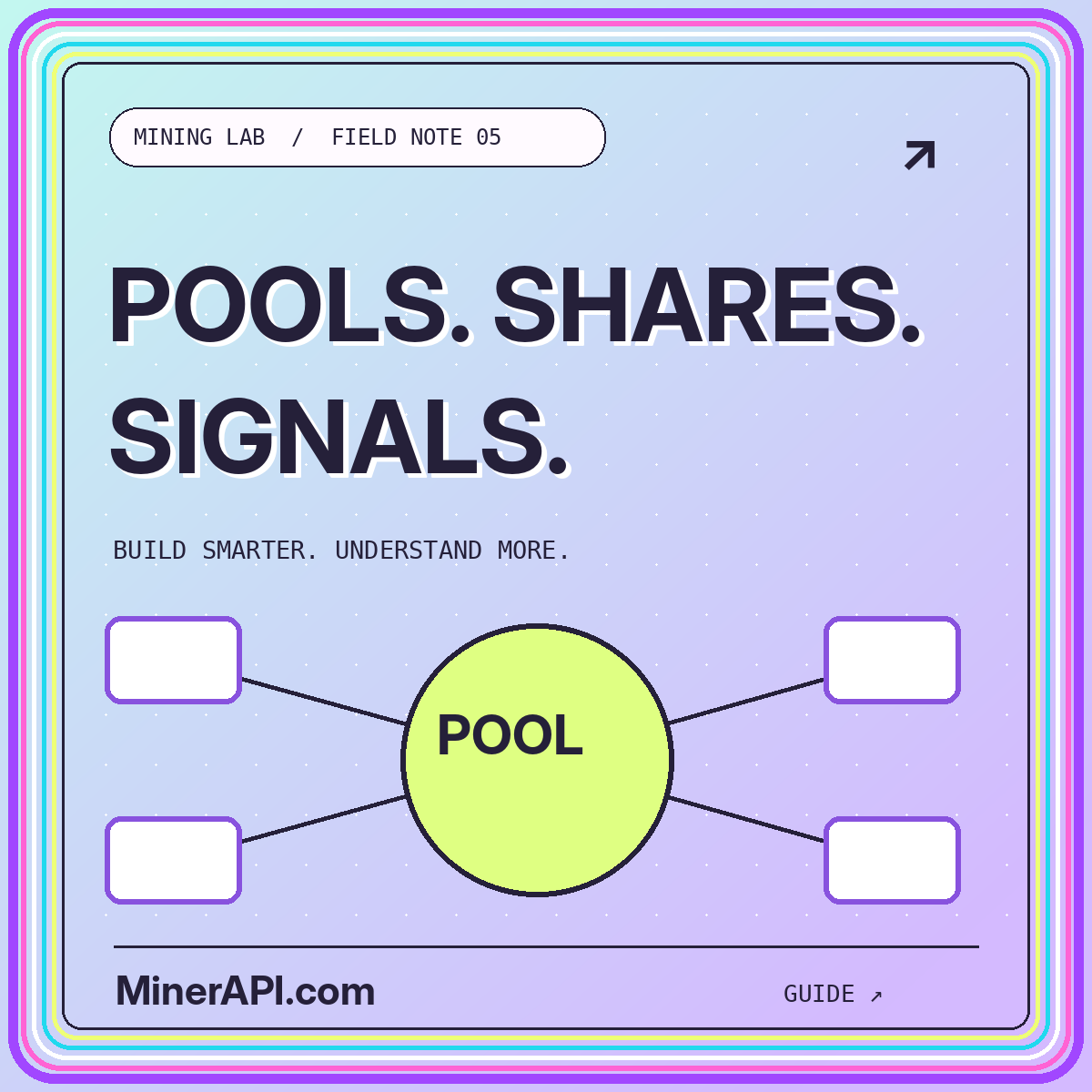
Mining Pool APIs and Stratum: Know the Difference
Design a source-aware pool view that keeps job transport, worker identity, share observations, and account reporting in their proper places.
Read the field guide 6 min ↗
ASIC Miner API: Build Reliable Telemetry
Turn device-specific responses into a dependable contract with capability checks, sensor context, and a tested normalization layer.
Read the field guide 7 min ↗