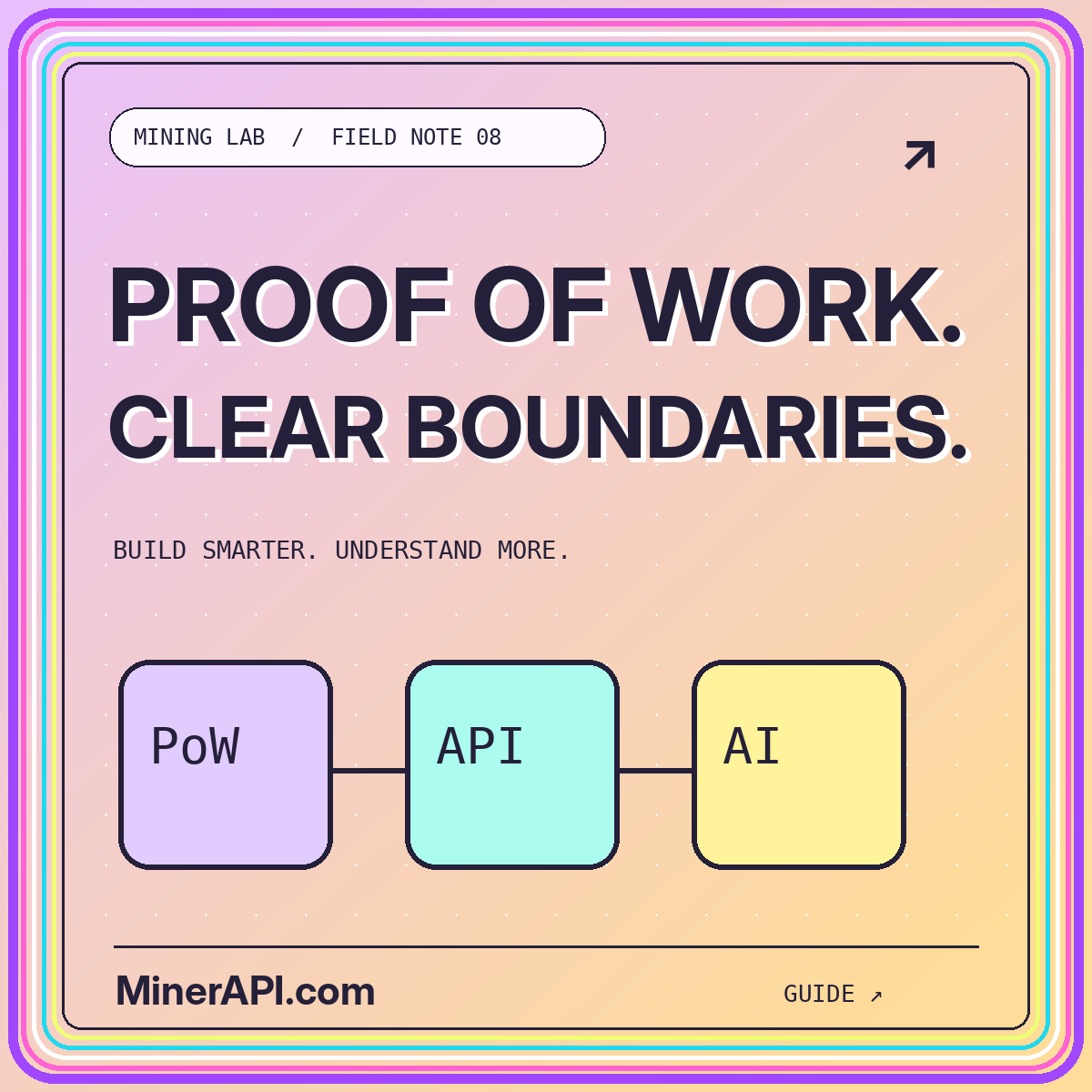
A page full of blockchain logos can make very different systems look interchangeable. A mining device API, a node RPC interface, a wallet connection, and an AI prompt workflow may all use familiar developer tools, but they do not perform the same job. Naming those boundaries clearly is essential when designing a website or application that discusses several ecosystems together.
This guide explains a practical way to separate proof-of-work monitoring from wallet and network integrations. It is an architecture and terminology guide, not a recommendation to use a particular chain or wallet. The Proof of Work overview and Integrations directory show how MinerAPI.com organizes these topics without implying that a displayed logo represents an installed connection.
Start with the role, not the logo
For every component, write a one-sentence role description. A device interface reports or manages a piece of equipment. A node interface exposes information or operations from a node. A wallet interface handles wallet-related interactions under its documented permissions. An application workflow uses these components for a specific user task. A brand name alone does not tell you which role is relevant.
The Ethereum explanation of The Merge documents Ethereum's transition from proof of work to proof of stake in September 2022. This is a concrete example of why an old “Ethereum GPU mining” label should not be reused for current Ethereum mainnet. A network can remain relevant to a blockchain application without belonging in its proof-of-work mining category.
Keep device monitoring in its own domain
A mining device response should identify the equipment, the reported workload, the measurement source, and the observation time. Device metrics such as available temperature or fan information are operational observations. They do not automatically establish ownership of cryptocurrency, authorization to spend funds, or permission to act through a wallet.
Build device monitoring around the actual hardware and firmware documentation. Avoid selecting an adapter from the name of a wallet a user happens to recognize. If the application later combines device observations with other data, preserve the source boundaries in the model. A dashboard can show several related panels while making it clear which panel comes from a miner, which comes from a node, and which is only an illustrative example.
Treat node data as a distinct source
A node can provide information that is useful to a mining application without observing a private mining rig. Keep node identity and network identity explicit. Do not label a network estimate as the hashrate of an individual worker or assume that the presence of a node connection gives your application access to device sensors.
Define the minimal node information your feature requires and document the exact interface you use. Store its timestamps and network context separately from device telemetry. If a node is unavailable while the collector still reaches the rig, the application should show that split condition. A single “everything online” badge hides too much. Source-specific states create a more honest and more useful picture for both developers and operators.
Understand what a wallet connection would add
Before adding a wallet button, identify the task it would support. Does the application genuinely need an address, a signature, or a transaction request? A read-only guide to ASIC telemetry may need none of these. Adding a connection prompt solely because other blockchain sites have one increases complexity without helping the visitor complete the page's actual task.
For a future wallet-enabled feature, verify the wallet's current documentation and supported networks, then request only the permissions necessary for the visible action. Keep private keys and recovery phrases out of the application entirely. MinerAPI.com does not request wallet access. Its wallet icons identify ecosystem topics, and its working interactions use public static samples. This distinction keeps the site useful without presenting an unimplemented connection as an available product feature.
Do not make icons do the work of documentation
An icon can help a visitor scan a page, but it cannot explain compatibility. Pair every ecosystem item with a short description of its role and a link to a relevant guide. Avoid labels such as “fully supported” unless you have a defined feature, a tested integration, and evidence for the scope of that claim. Compatibility should be described at the operation level.
A practical integration record can state the interface category, the documentation consulted, the supported operation, and the version or environment tested. For a reference-only website, the record should instead make its educational purpose clear. This is not about adding a long disclaimer to every card. It is about choosing accurate labels so the main interface does not create expectations that the underlying implementation cannot meet.
Keep prompt mining separate from consensus
MinerAPI.com uses AI prompt mining as a label for discovering, organizing, and evaluating prompt candidates. That workflow does not use a cryptocurrency consensus mechanism merely because the word mining appears in its name. Its useful measurements concern task performance, evaluation cases, latency, and version history rather than hashrate or block production.
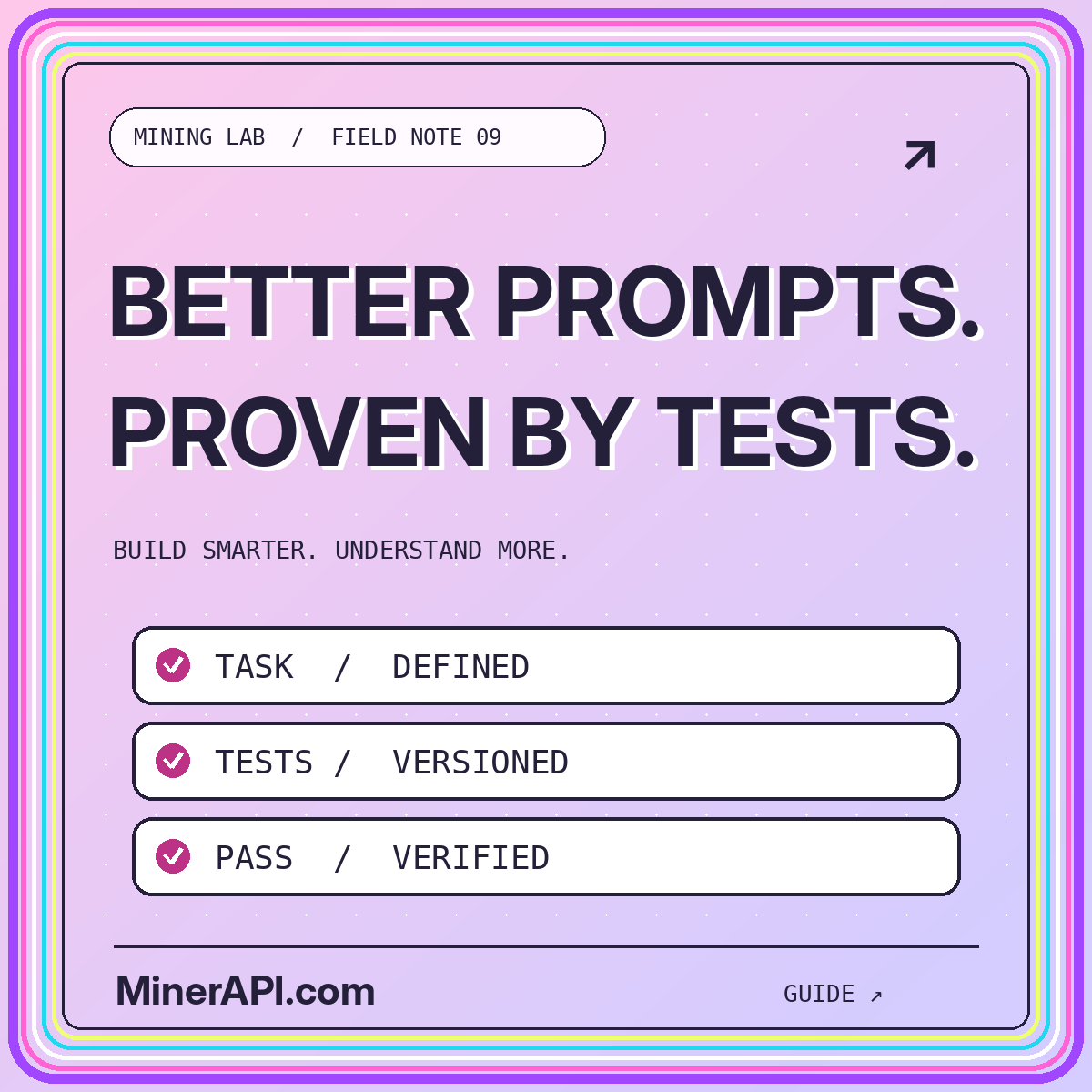
Give this workflow a separate schema and section. A prompt record might contain a task name, a version, input variables, and a reference to an evaluation result. It should not inherit fields such as worker hashrate just to fit a generic dashboard component. Shared visual styling is fine; shared semantics require evidence. The AI Prompt Miner API page explains the intended workflow and links to its dedicated guides.
Design the navigation around real questions
A visitor looking for an ASIC temperature field has a different question from a developer researching wallet permissions. Put those paths in clearly named sections. Use a topic overview to explain the difference before linking to implementation details. Keep the homepage broad enough to introduce the platform but precise enough that users know which category matches their goal.
For example, a mining navigation group can contain Bitcoin, ASIC, GPU, proof of work, and pools. A developer group can contain the API reference, sample clients, and security. An AI group can contain prompt evaluation and workflow design. This structure is easier to maintain than a single list of every recognizable blockchain term. Each page gets a distinct purpose, and internal links become explanations rather than a collection of keyword variations.
Evaluate an integration claim with a small checklist
Ask what operation is implemented, where it runs, what permissions it needs, and how its result is verified. Then inspect its failure behavior. A decorative card with a logo and a button is not an integration. A sample response is useful documentation, but it is not evidence of a live service. These distinctions should appear in the product language as well as in engineering notes.
For a testable claim, define an acceptance scenario with a known input and expected result. Record the environment used and avoid expanding the claim beyond that evidence. If you have only built a static fixture endpoint, describe it as a fixture endpoint. That is a complete and useful feature in its own right. Overstating it makes the next developer's job harder because they must discover the boundary through failure.
Keep the terminology current without rewriting history
Review pages when a protocol role, supported interface, or documented capability changes. Avoid headlines tied to a current year unless the body actually addresses that period. A durable page can explain principles while linking its one main technical reference to the relevant official documentation. Date labels should not be used as a substitute for checking the substance.
Maintain a small topic map with the role each page covers and the claims that require verification. This makes it easier to update a specific integration description without accidentally implying that the whole website changed its technical purpose. On a multi-topic developer site, careful categorization is a form of maintenance. It protects both the visitor's understanding and the consistency of the underlying examples.
Conclusion: shared branding does not mean shared mechanics
Proof-of-work monitoring, node data, wallet interactions, and prompt evaluation are distinct domains. Give each its own role, data contract, and evidence of implementation. Use icons as navigation aids rather than compatibility claims. A clear boundary is not a limitation of the design; it is what lets a colorful, multi-topic website remain understandable and technically honest.