A mining API can expose more than measurements. Depending on its design, it may reveal network layout, account identifiers, equipment inventory, or administrative operations. Security therefore begins with deciding what the application genuinely needs to know and do. A public documentation page should not inherit the privileges of the collector that reaches private equipment.
This guide outlines a defensive architecture for systems you own or are authorized to manage. It focuses on read-only access, object permissions, secret handling, request limits, and auditability. The Security page summarizes the website's own boundaries, and the API reference documents the public sample resources without pretending they connect to a live fleet.
Map the trust boundaries first
The OWASP API Security Top 10 for 2023 identifies risks including broken object-level authorization, broken authentication, unrestricted resource consumption, and security misconfiguration. Use these categories as prompts for design review, not as a checklist that automatically certifies an application. The important task is tracing how a request moves across your actual boundaries.
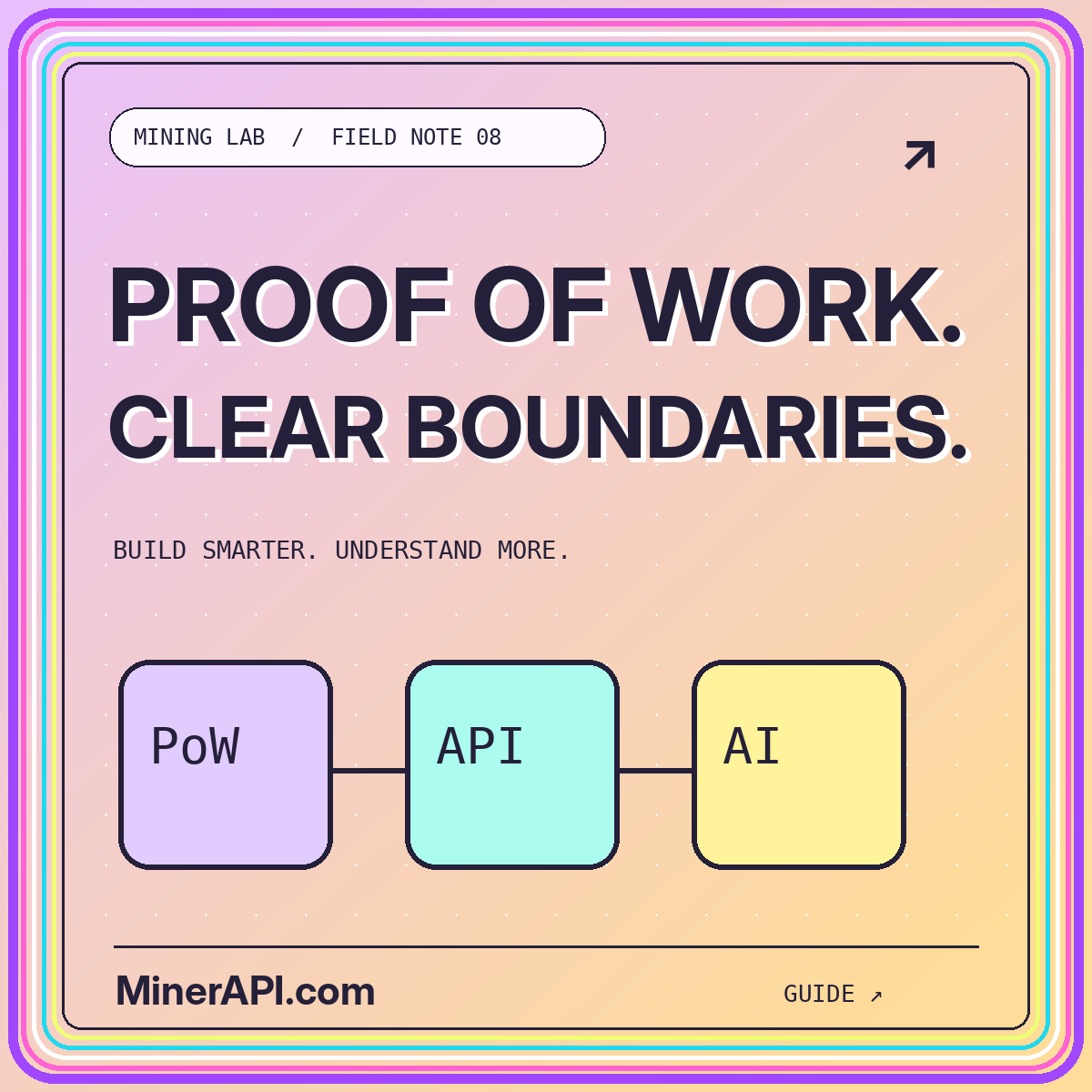
Draw the path from the browser to a presentation service, from that service to a collector, and from the collector to authorized equipment. Mark where credentials are stored and where permissions are checked. A static website can safely publish documentation and intentionally public fixtures. It cannot protect a secret that has already been included in its HTML or JavaScript. Keep privileged operations behind a boundary that is not delivered to every visitor.
Separate observation from administration
Start with an identity that can read only the observations needed for the application. A worker overview does not inherently require pool changes, restarts, or operating-profile edits. Keep those operations out of the monitoring path even when a device offers them through the same underlying interface. The application should not accidentally gain control privileges because one developer found an all-purpose credential convenient.
When administrative operations are needed, define a separate permission model and workflow. Require an explicit target and an explicit action, then record the outcome. Consider whether particularly consequential actions need an additional review step under your organization's procedures. The point is not to add decorative confirmation boxes. It is to ensure that a routine status viewer cannot silently become a control plane with permissions nobody intended to grant.
Check access to every requested object
An authenticated user is not automatically authorized to view every worker. Define which account, team, or location owns each object, and check that relationship on every relevant request. Do not rely on the interface hiding a link. A caller can construct a request independently of the buttons displayed in a browser.
Use test accounts with deliberately different permissions. Verify that a worker identifier belonging to another account does not return its data, even when the identifier is known. Apply the same reasoning to exports, historical observations, and aggregate views. An apparently harmless fleet total can disclose information across a boundary if the aggregation includes unauthorized workers. Authorization belongs in the data access path, not just in navigation or client-side filtering.
Keep secrets out of the shipped website
Do not place device passwords, pool credentials, private tokens, or provider keys in downloadable examples. Use placeholders only in documentation that clearly explains where an authorized private runtime must supply a value. For public examples, prefer sample resources that require no secret at all. MinerAPI.com's bundled JSON fixtures follow that pattern and are intended to remain public.
Review the entire delivery surface, including source maps, old build files, screenshots, logs, and sample configuration. A credential removed from the visible interface may still exist in an asset or archive. Maintain a rotation procedure for accidental exposure and document who can revoke the affected access. Do not treat obfuscation, an unusual filename, or a hidden HTML element as a security boundary. Anything delivered to a visitor can be inspected.
Minimize the data returned to each client
Return the fields needed for the task rather than forwarding an entire upstream payload. A public worker card may need a label and an observation state, but not private network addresses or account configuration. Build a response schema that deliberately selects allowed fields. This is easier to review than a rule that attempts to remove a growing list of sensitive fields after the fact.
Keep operational diagnostics in a restricted environment with its own access and retention policy. Public errors should provide a safe explanation and a diagnostic identifier, not a complete stack trace or raw credential-bearing response. Review derived fields too. A human-readable error message assembled from an upstream string may contain information that the structured response otherwise excludes. Treat logs, notifications, and exports as separate output surfaces that each need review.
Bound requests and validate responses
Set limits on time, concurrency, response size, and retry attempts. A failing dependency should not cause unbounded work in the collector. Validate the shape and types of upstream responses before publishing normalized observations. A valid JSON document can still violate your contract or contain values your interface cannot interpret safely.
Use allowlisted destinations for collectors rather than letting an arbitrary public request choose a private network address to query. The specific control belongs in the environment that performs the request. A browser field restriction alone would not enforce it. Keep the first version narrow: known equipment, documented read operations, and finite collection budgets. Expanding the system is easier when the permitted request path is explicit and testable from the beginning.
Plan for action retries and uncertain outcomes
A timeout after an administrative request does not necessarily mean the operation failed. Your system may have lost the response after the target accepted the action. Before implementing retries, define how the result can be reconciled. Where the actual interface supports an idempotency mechanism, use it according to that interface's contract. Do not invent an idempotency header and assume a device will honor it.
Keep a record of the requested target, authorized actor, action, and known outcome. Represent uncertain outcomes explicitly. A control panel that always changes an ambiguous response to “failed” can encourage repeated actions and complicate recovery. This is one reason to keep the initial public examples read-only. The ASIC telemetry article shows how much useful monitoring can be built without adding device-control operations.
Test the negative paths deliberately
A security review should include requests that ought to fail. Test missing credentials in your private service, unauthorized object identifiers, unsupported methods, excessive request sizes, malformed upstream responses, and unexpected destination choices. Confirm not only that the request fails, but that it fails without exposing sensitive data or leaving a resource-consuming loop behind.
Keep these tests separate from destructive operational tests. Use fixtures and isolated environments rather than experimenting against equipment that someone depends on. Record the expected status, safe error shape, and audit event for each case. When a new endpoint is added, require a corresponding authorization and failure test. A consistent negative-path suite is more dependable than relying on one reviewer to remember every boundary during a busy release.
Make incident handling part of the design
Write down how to revoke access, rotate a credential, disable an adapter, and notify the responsible operator. Decide where security reports should be sent and what information should not be included in an initial email. An incident process that exists only in one person's memory will be difficult to use when that person is unavailable.
Practice with a harmless scenario, such as a fictional token exposed in a test fixture. Trace how you would identify its scope, revoke it, confirm the revocation, and review related activity. Keep the exercise focused on your own authorized systems. Use the results to improve secret handling and audit records rather than merely adding another policy statement that does not change the implementation.
Conclusion: give each layer only what it needs
Mining API security is strongest when public content, private collection, and administration remain separate. Enforce permissions on objects, minimize returned data, protect secrets outside the browser, and bound all requests. Test the paths that should fail and prepare for uncertain outcomes before adding control features. A narrow, well-tested monitoring integration is a better foundation than a broad interface with unclear authority.