A Bitcoin miner API becomes useful when it answers an operational question: is a worker doing the job you expect, and can you explain a change without guessing? A number labeled hashrate is not enough. You also need its source, measurement window, units, and observation time. This guide lays out a practical design for a read-only mining integration, from choosing your first data source to testing a dashboard against missing and delayed responses.
The goal is not to build every feature at once. Start with a trustworthy view of one worker. Make failures visible, document the fields, and expand only after the small version behaves predictably. The Bitcoin Miner API topic page and sample API reference provide a companion path through the examples on MinerAPI.com.
1. Separate the three sources of mining information
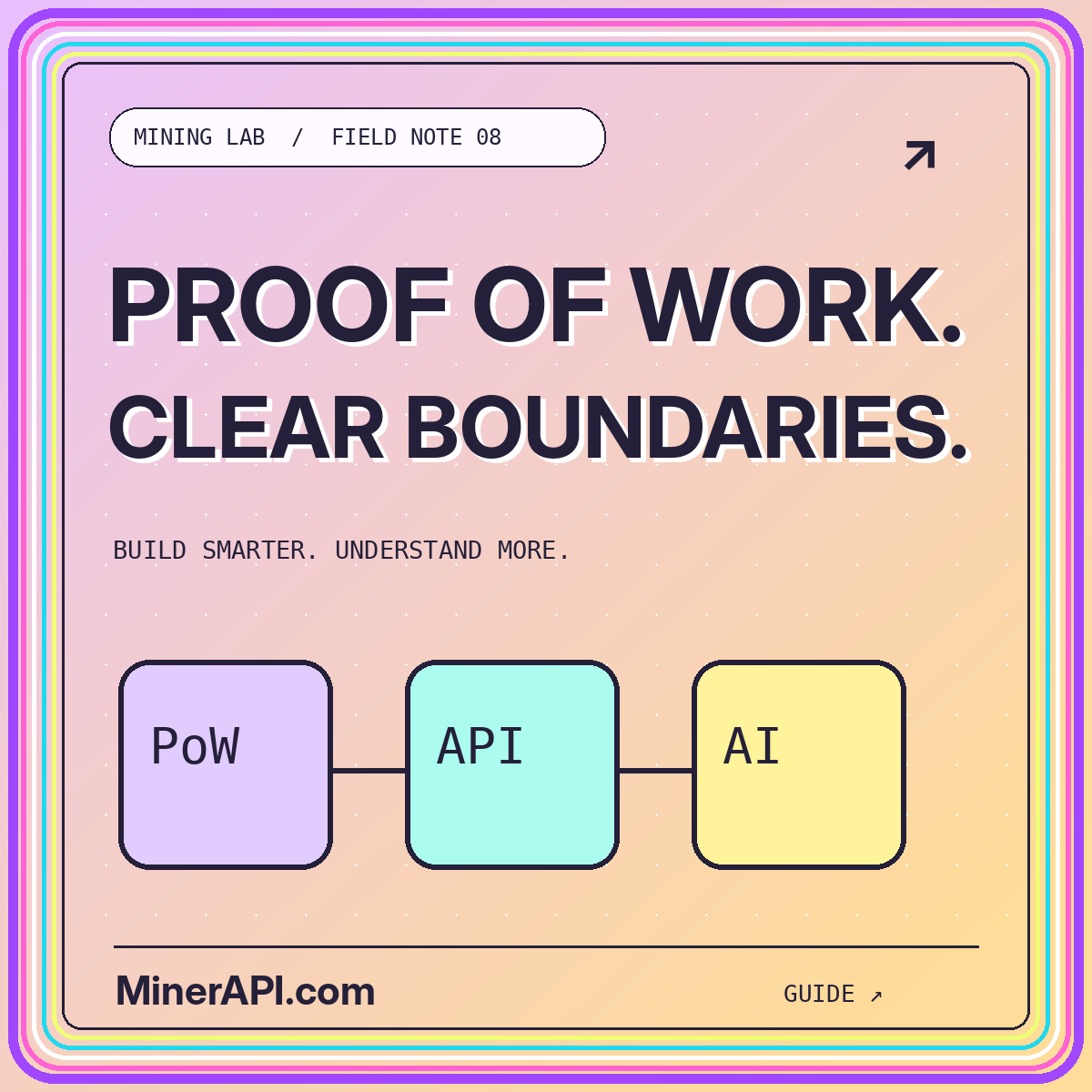
A Bitcoin node, a miner, and a mining pool answer different questions. The Bitcoin developer reference for getmininginfo documents node-level mining information such as block height, difficulty, and network hashrate. These fields describe the node's view of the network. They are not measurements of a particular ASIC's cooling fans, chip temperature, or electrical consumption.
Use that distinction as the foundation of your data model. Put network observations in one resource, device observations in another, and pool-side accounting in a third. Record the source beside each value rather than merging everything into an anonymous metrics object. A dashboard can combine the views visually while still preserving where the evidence came from. That makes disagreements inspectable instead of looking like random errors.
2. Write down the first question before the endpoint
For a first integration, choose a question such as: which configured workers have fresh telemetry? This is narrower and easier to test than “show mining performance.” Define what counts as a configured worker, the expected polling interval, and the period after which you will call an observation stale. These are design decisions for your environment, not universal constants.
A small acceptance test might contain three fictional workers: one recently observed, one observed too long ago, and one never observed. The interface should distinguish all three. Do not turn a missing worker into a zero-hashrate worker, because zero is a measurement and missing is an absence of evidence. Write the expected screen state before implementing the collector. The test then becomes a contract for both the API and the interface.
3. Create a small, explicit response contract
Use a stable worker identifier, an algorithm label, an observation timestamp, a collection timestamp, and a schema version. Keep the display name separate from the identifier so an operator can rename a rig without creating a new time series. For each numeric field, choose either a documented canonical unit or a value-and-unit object. Do not make consumers infer units from the size of the number.
For example, a field named hashrate_th_s is more explicit than speed. A temperature field should identify whether it describes an inlet, a chip, or another sensor. Optional values should be nullable, with an accompanying reason when practical. Preserve the original payload in a controlled diagnostic store outside public pages so a parsing error can be investigated without redesigning the public response.
4. Poll gently and treat collection as a separate system
Design a collector that requests only the data it needs, uses a timeout, and limits simultaneous work. Begin with a conservative interval approved for the actual device interface. Your own benchmark should determine whether the polling pattern is sustainable. A fast laptop response does not establish what an older controller can handle while operating normally.
Introduce small scheduling offsets between workers so every request does not arrive at the same instant. Retry only within a defined budget. An unreachable device should not monopolize the collector or trigger an unlimited request loop. Record collection errors as their own observations. A healthy web page can still display stale device information, so the presentation layer must never substitute its own successful refresh for the freshness of the underlying measurement.
5. Build the dashboard around evidence
Show the latest observation time next to the main value, not in a hidden settings page. Add a clear label for each averaging window and separate the device reading from any pool estimate. A useful worker card can stay compact: name, status, latest hashrate, temperature availability, and age of the data. Details belong in the expanded view rather than competing for attention on every card.
For charts, leave gaps where observations are missing. Connecting every point across an outage creates the visual impression that performance was continuously measured. Keep the original timestamps and choose a documented aggregation method when reducing a long history. Include a text summary or table for important values so a visitor does not have to interpret a decorative chart to understand the state of the worker.
6. Use fixtures before connecting hardware
Create sample payloads for healthy, stale, unavailable, and malformed responses. These fixtures make interface work possible without exposing a miner or waiting for a real fault. Keep them deterministic: a test should get the same data every time unless the test explicitly selects a different scenario. Label them as samples in the response and in the interface.
MinerAPI.com's dashboard demo reads bundled JSON examples, not a mining farm. Use the quickstart to inspect a response and adapt its structure. Before replacing a fixture with a collector, test extra fields, absent optional fields, incorrect types, and an unsupported schema version. The consumer should handle reasonable additions without crashing, while rejecting changes that would make its interpretation unsafe or misleading.
7. Keep monitoring access narrower than control access
An overview dashboard rarely needs permission to change pool credentials, alter hardware settings, or restart a machine. Design read-only access first and keep credentials outside browser-delivered code. A static page is a good place to render public documentation or approved sample data; it is not a hiding place for a device password or a private collector token.
Plan an access boundary around the collector. Document which machines it may reach and which commands it may issue. Scrub usernames, network addresses, and secrets from public logs and examples. When an administrative feature is eventually needed, give it a separate authorization decision and a visible record of the attempted action. Do not assume that access to a worker's status should automatically authorize changes to that worker.
8. Review a realistic failure sequence
Walk through a fictional incident before launch. A worker stops responding, the collector times out, the last valid reading becomes stale, and the operator opens the dashboard. What do they see? They should see the last known value with its age, the collection failure, and the next useful diagnostic step. They should not see an automatically invented explanation such as a failed fan.
Now restore the device. Verify that its identity survives reconnection, old errors remain available for investigation, and the dashboard returns to a current state without manual page surgery. Test a collector restart separately from a worker restart. These are different events and should not collapse into the same “offline” signal. The monitoring alert guide extends this exercise into an actionable incident workflow.
Conclusion: make one observation dependable
A good Bitcoin miner API starts with honest boundaries. Node information is not device telemetry, missing readings are not zeros, and a sample dashboard is not a live service. Preserve those distinctions in your response schema and the interface becomes easier to trust.
Your next step is small: choose one worker question, write three representative fixtures, and build a read-only view that handles them correctly. Add collection, history, and operational alerts after that foundation is stable. More endpoints will not rescue unclear measurements; clear measurements will make every later endpoint more useful.